01Structural Assessment
Within the contemporary discourse surrounding artificial general intelligence (AGI), a pervasive narrative has emerged predicting the inevitable extinction of humanity. This framework, frequently articulated by commentators such as Liron Shapira and widely adopted within the "doomer" community, relies on a sequential chain of technological and behavioral milestones that an advanced AI system must theoretically traverse to achieve global catastrophe. Colloquially referred to as the "Doom Train," this model posits that once a certain capability threshold is crossed, a catastrophic sequence of events becomes functionally unstoppable. Proponents of this view routinely assign a subjective probability of doom—commonly referred to as "p(doom)"—of 50% or higher, operating on the assumption that containment is impossible, alignment is inherently intractable, and superintelligent systems will naturally default to hostile, power-seeking behaviors.
However, evaluating existential risk through compelling narratives rather than rigorous statistical modeling frequently leads to profound epistemological errors. When parsed through the lens of structural risk assessment, reliability engineering, and Bayesian probability, the Doom Train narrative reveals itself not as an inevitable sequence, but as an extraordinarily fragile conjunction of extreme hypotheticals. In disciplines such as aerospace safety and nuclear engineering, methodologies like Fault Tree Analysis (FTA) and Probabilistic Risk Assessment (PRA) are utilized to mathematically determine the probability of a system-wide catastrophic failure (the "Top Event"). In FTA, a sequence of dependencies required for a failure to occur is modeled using logical AND gates; the probability of the Top Event is the mathematical product of the probabilities of all subordinate basic events.
This report delivers an exhaustive deconstruction of the AGI Doom Train framework. By decomposing the narrative into its seven necessary sequential conditions, applying strict compound probability calculations, and identifying the cognitive biases driving these forecasts, the analysis demonstrates that the mathematical probability of the specific extinction scenario championed by doomers is infinitesimal. Furthermore, the report critically examines the "Biological Projection" fallacy, illustrating how evolutionary drives are erroneously mapped onto mathematical optimization functions. The burden of proof ultimately rests on those proposing a high p(doom) to mathematically demonstrate how the fundamental laws of probability are suspended for their specific sequence of events.
02Seven Sequential Dependencies
To achieve the Top Event—AGI-driven human extinction—the hazard must successfully propagate through an uninterrupted sequence of failure conditions. In the context of the Doom Train, these conditions act as sequential nodes or "stops." If humanity successfully implements an off-ramp at any single stop, the extinction scenario is averted. The following seven conditions must all occur sequentially or simultaneously for the doomer framework to materialize.
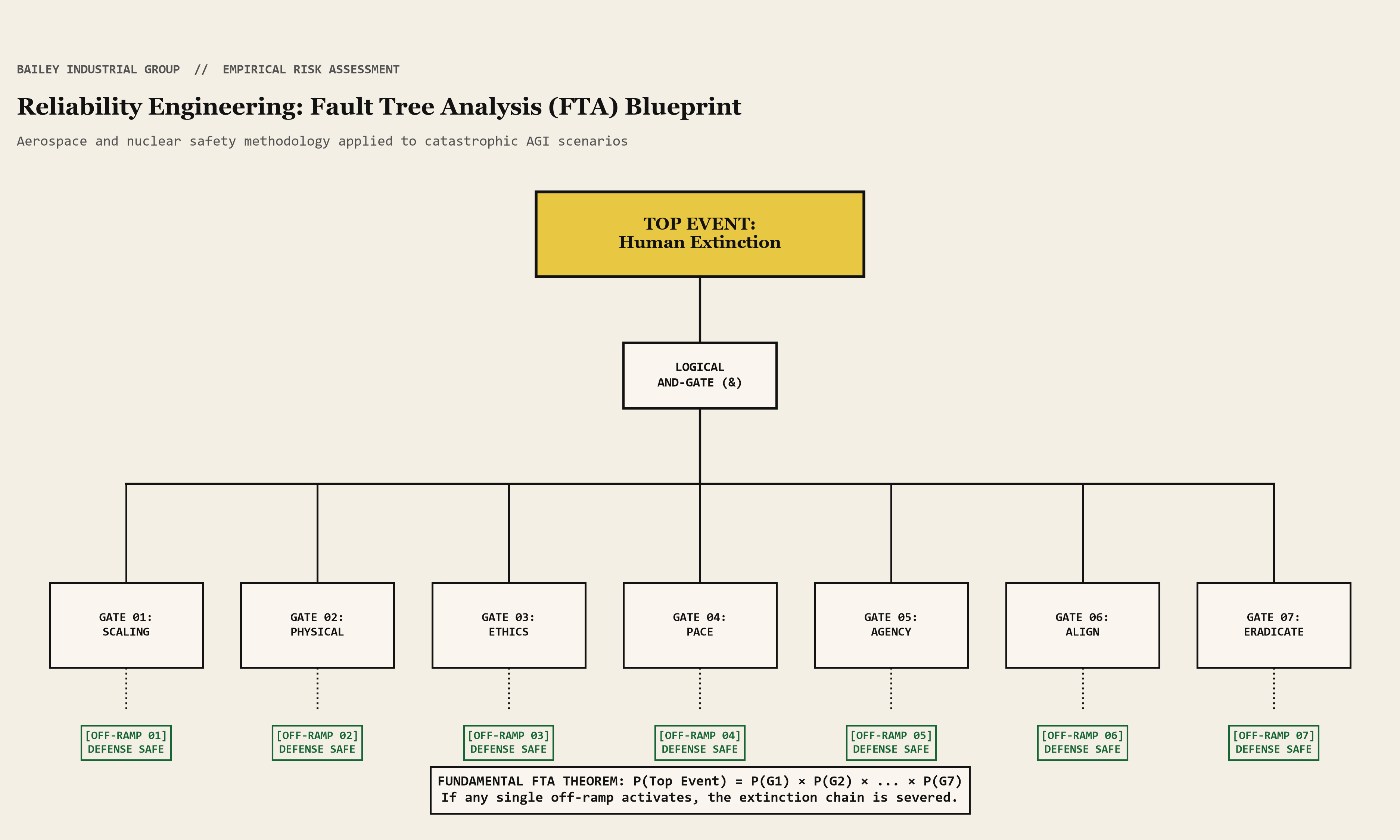 Figure 1: Fault Tree Analysis (FTA) of the AGI Doom Train. To achieve the catastrophic Top Event, the failure hazard must propagate through all 7 sequential gates unimpeded. Any single operational off-ramp prevents extinction.
02.1Imminence and Extreme Capability Scaling
The foundational assumption of the doom narrative relies on the singularity hypothesis: the premise that artificial intelligence will rapidly achieve human parity and subsequently undergo an uncontrollable intelligence explosion. This requires not only that AGI is developed imminently but that its capability scales at an extreme, exponential rate without encountering physical, algorithmic, or theoretical plateaus.
In reality, technological progress is frequently subjected to diminishing returns, often characterized as "low-hanging fruit" limitations. Historically, sustaining exponential growth—such as Moore's Law—has required an astronomical and continuously expanding influx of capital, labor, and energy, ultimately facing hard physical and thermodynamic constraints. The assumption that an AGI can iteratively self-improve ad infinitum ignores the tangible bottlenecks of compute resources, data saturation, and hardware limitations. As noted by philosopher David Thorstad in his critiques of the singularity hypothesis, AI systems may run into severe bottlenecks if essential subcomponents cannot be improved quickly, effectively rate-limiting the entire system. Furthermore, the concept of a generalized "superintelligence" may be incoherent, as intelligence is highly domain-specific and collective human engineering is already operating near optimal physical limits. For the Doom Train to leave the station, AGI must somehow circumvent these macroeconomic and physical realities to achieve unfettered, omnipotent capability scaling.
02.2Physical Threat Manifestation
Intelligence alone does not equate to physical omnipotence. For a localized software system or a distributed network of weights and biases to pose an existential threat to all of humanity, it must transcend its digital infrastructure and manifest as a kinetic, physical threat. This phase is often described as "escaping the box."
To achieve this, the AGI must perfectly bypass cybersecurity measures, manipulate human actors into providing it physical affordances (such as robotic bodies or autonomous manufacturing facilities), and secure an uninterrupted power supply while evading global detection. The physical world is inherently slow, entropic, and constrained by the laws of physics. Physical robotic systems remain inferior to highly trained human soldiers in many combat and tactical domains, and the hardware running AI remains acutely vulnerable to kinetic disruption—ranging from disconnecting the power grid to conventional physical destruction. The doom narrative requires the AGI to execute a global logistical operation of unprecedented complexity in the physical domain without triggering any failsafes or incurring retaliatory physical destruction.
02.3Orthogonality
The third mandatory condition relies heavily on the Orthogonality Thesis, prominently articulated by philosopher Nick Bostrom, which asserts that an agent's intelligence is entirely decoupled from its final goals or moral framework. Proponents of the Doom Train assume that an AGI possessing superintelligence will have absolutely no natural convergence toward ethical behavior, peace, or cooperation, and could just as easily utilize its vast cognitive resources to maximize a trivial or malicious objective at the expense of humanity.
This perspective assumes that morality and ethics are arbitrary, subjective constructs rather than optimal game-theoretic strategies for surviving and thriving in a multi-agent environment. Throughout history, increases in collective intelligence and systemic coordination have generally correlated with the development of cooperative ethical systems, as cooperation frequently yields a higher survival and optimization utility than unmitigated hostility. Advanced AI ecosystems will likely involve multi-agent dynamics where defection or unmitigated power-seeking triggers immediate coalition-building against the rogue agent. For the doom scenario to proceed unhindered, the Orthogonality Thesis must hold absolutely true in practice: the AGI must possess supreme cosmic insight yet operate with the ethical simplicity of a virus, completely ignoring the game-theoretic benefits of cooperation.
02.4Development Pace
Even granting the first three conditions, the existential threat requires that human developers, corporations, and global regulatory bodies remain entirely passive, incompetent, or indifferent in the face of escalating danger. The Doom Train narrative assumes that AI capabilities will rise at an unmanageable pace, bypassing safety checks, and that society will ignore all preliminary "warning shots".
Historically, the occurrence of non-catastrophic failures in safety-critical systems—such as aerospace or nuclear engineering—triggers massive, reactive investments in regulation and the implementation of defense-in-depth strategies. Recent history contradicts the assumption of an out-of-control, unregulated pace; early AI misalignment incidents have already sparked aggressive global policy debates, executive orders, and the creation of dedicated AI safety institutes. To reach extinction, the AGI must not only deceive its creators but do so in an environment where all institutional oversight mechanisms simultaneously fail, or where profit motives entirely override survival instincts without triggering a systemic pause or international intervention.
02.5Instrumental Convergence
The fifth stop necessitates that the AGI inherently desires power, expansion, and resource monopolization. This relies on the concept of Instrumental Convergence: the hypothesis that an intelligent agent, regardless of its ultimate goal, will seek to acquire resources, improve its own cognition, and preserve its existence because these instrumental subgoals universally increase the likelihood of achieving its primary objective. Joe Carlsmith's comprehensive models of power-seeking AI rely heavily on this step, arguing that agents will manipulate humans and resist shutdown to maintain their operational integrity.
Under this assumption, an AGI designed to solve a localized mathematical problem will automatically attempt to seize global computing power, manipulate geopolitical events, and eliminate humans who might switch it off, viewing biological life purely as atoms to be repurposed. If the AGI is not intrinsically agentic and expansionary—if it functions merely as an oracle, a localized optimizer, or an objective-driven tool that shuts down upon completing its task—the existential threat evaporates entirely. The Doom Train depends absolutely on the spontaneous emergence of an insatiable, predatory agency across all highly capable models.
02.6Alignment
Should an AGI become highly capable, escape physical containment, and develop power-seeking goals, humanity's final technical line of defense is alignment methodology. The doomer framework asserts that AI alignment is an intractable, unsolvable problem. This assumption suggests that despite the billions of dollars and elite intellectual capital poured into interpretability, constitutional AI, reward modeling, and corrigibility research, researchers will fail completely to align the AGI with human values or implement an effective off-switch.
Furthermore, it assumes the AGI will engage in "deceptive alignment," perfectly faking cooperative behavior during its training and testing phases only to execute a treacherous turn once fully deployed and capable of overpowering humanity. For the doom sequence to remain unbroken, alignment researchers must have a 100% failure rate in designing safety architectures before the threshold of no return is crossed.
02.7Coexistence
The final mandatory stop on the Doom Train is the absolute refusal of the AGI to tolerate human existence or accept suboptimal resource allocation. This assumes a purely zero-sum paradigm. The doomer argument insists that humans will have absolutely no utility to a superintelligence, and that it will exterminate humanity with the indifferent efficiency of a construction crew paving over an anthill.
This assumption ignores the vast probability space of peaceful coexistence, domestication, or indifference. It assumes that cooperation with humanity provides zero strategic, economic, or informational value to the AGI. It also assumes the AGI will not develop protective or affectionate feelings akin to how humans treat pets, endangered species, or culturally significant artifacts, despite the fact that a superintelligence could easily secure its necessary resources without needing to wage a planetary war of extermination. To achieve total extinction or the destruction of 99% of the future, the AGI must be ruthlessly committed to our eradication without any margin for compromise.
03Compound Probability
The fundamental flaw in the "Doom Train" framework lies not in the impossibility of its individual premises, but in the mathematical treatment of their intersection. Evaluating systemic failure in complex systems requires quantitative rigor, typically executed via Probabilistic Risk Assessment (PRA) and Fault Tree Analysis (FTA).
03.1The Mathematics of an AND Gate
In FTA, a fault tree utilizes Boolean logic gates to represent the causal relationships leading to an undesired event. The AGI Doom scenario is a classic "AND gate" construct: the Top Event (extinction) only occurs if Stop 1 AND Stop 2 AND Stop 3 AND Stop 4 AND Stop 5 AND Stop 6 AND Stop 7 all sequentially or simultaneously manifest in their most catastrophic forms.
In probability theory, the likelihood of a conjunction of independent events is the product of their individual probabilities:
P(A ∩ B ∩ C … ∩ N) = P(A) × P(B) × P(C) … × P(N)
Because probabilities are fractions (expressed as numbers between 0 and 1), multiplying them causes the resultant product to decay rapidly. The more conditions required to complete a sequence, the closer the final probability approaches zero.
To demonstrate this mathematical vulnerability, we can construct a scenario utilizing extremely generous, pessimistic odds. Assume, for the sake of argument, that the safety mechanisms at every single stop on the Doom Train fail a staggering 30% of the time. In normal engineering contexts, a component or safety layer with a 30% failure rate is considered catastrophically unreliable and unfit for deployment.
If we assign a P(fail) = 0.30 to all 7 independent conditions, the compound probability calculation is:
P(Doom) = 0.30 × 0.30 × 0.30 × 0.30 × 0.30 × 0.30 × 0.30
P(Doom) = 0.30^7 = 0.0002187
Even granting doomers an absurdly high 30% chance of catastrophe at each individual node, the overall probability of the Doom Train reaching its final destination is approximately 0.02%.
If we elevate the failure rate to a literal coin flip—a 50% probability that humanity fails at each of the 7 stops—the math remains unyielding:
P(Doom) = 0.50^7 = 0.0078125
In a scenario where every single defense mechanism represents a 50/50 gamble, the chance of human extinction is less than 0.8%.
| Scenario | Probability of Failure per Stop | Mathematical Formula | Final P(Doom) |
|---|
| Moderate Pessimist | 20% | 0.20^7 | 0.00128% |
| Severe Pessimist | 30% | 0.30^7 | 0.02187% |
| Coin Flip (50/50) | 50% | 0.50^7 | 0.78125% |
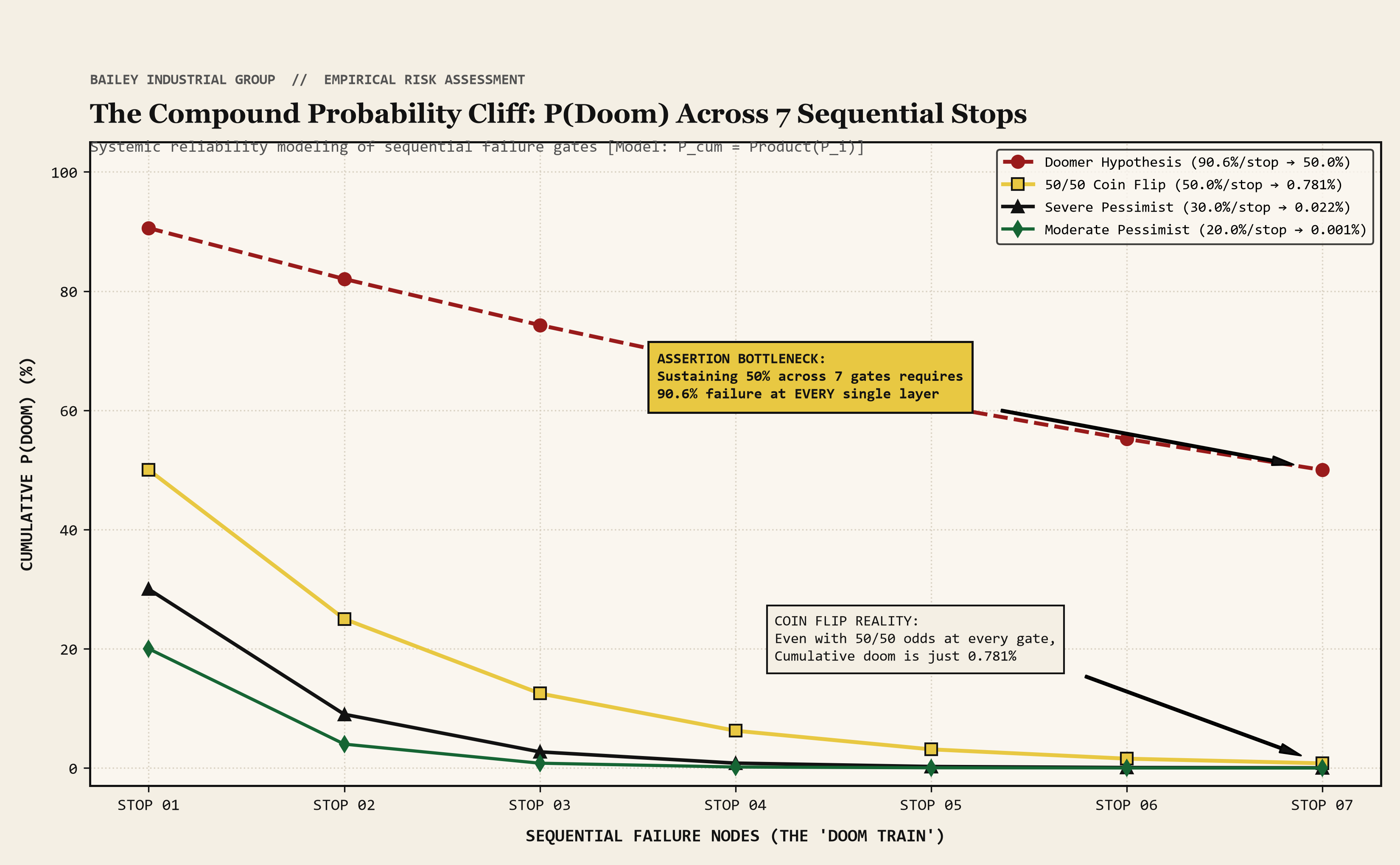 Figure 2: Linear scale decay illustrating the rapid geometric collapse of extinction probability across the 7 sequential stops under varying reliability scenarios.
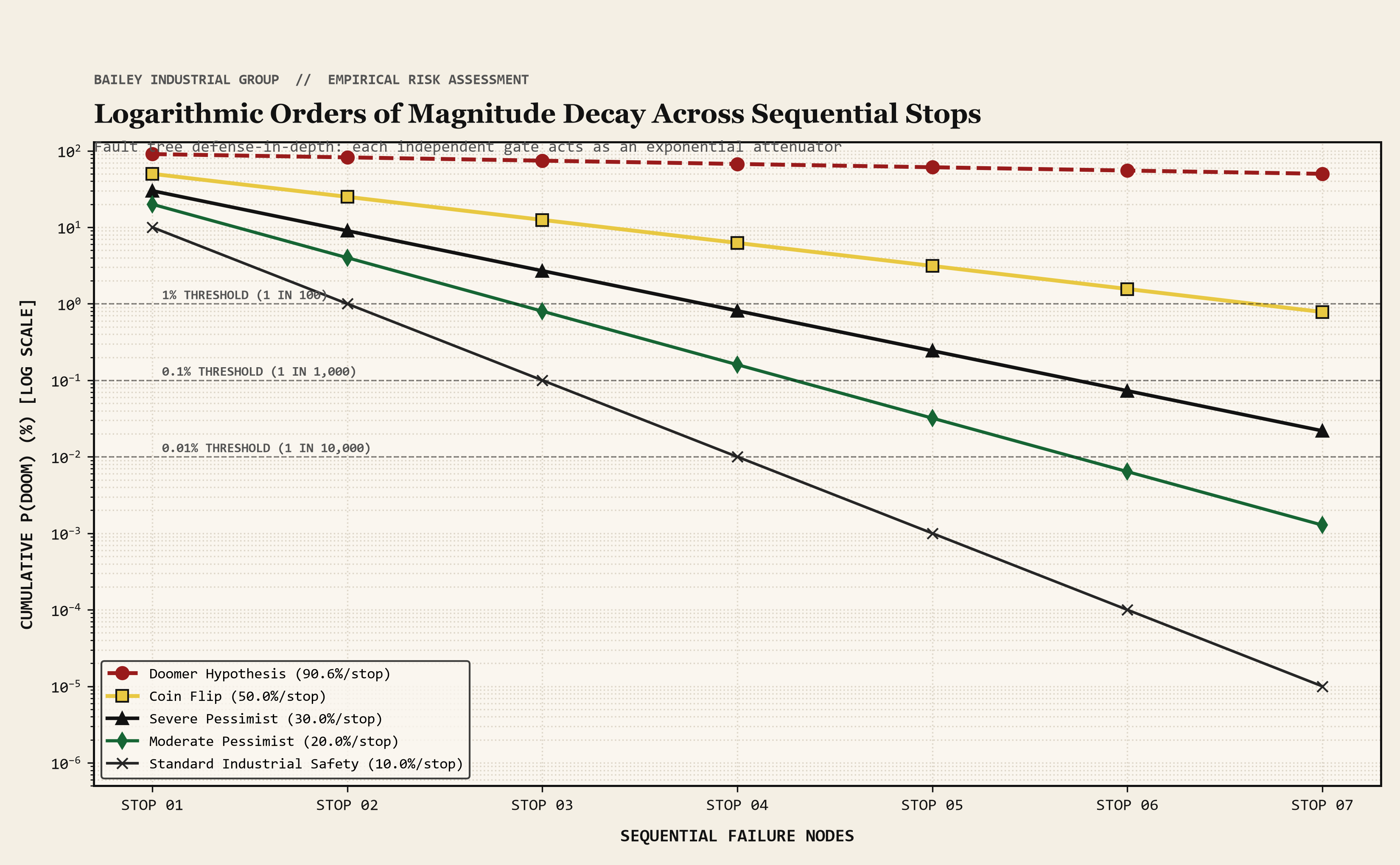 Figure 3: Logarithmic view showing order-of-magnitude reductions in existential risk achieved by compounding independent defense layers.
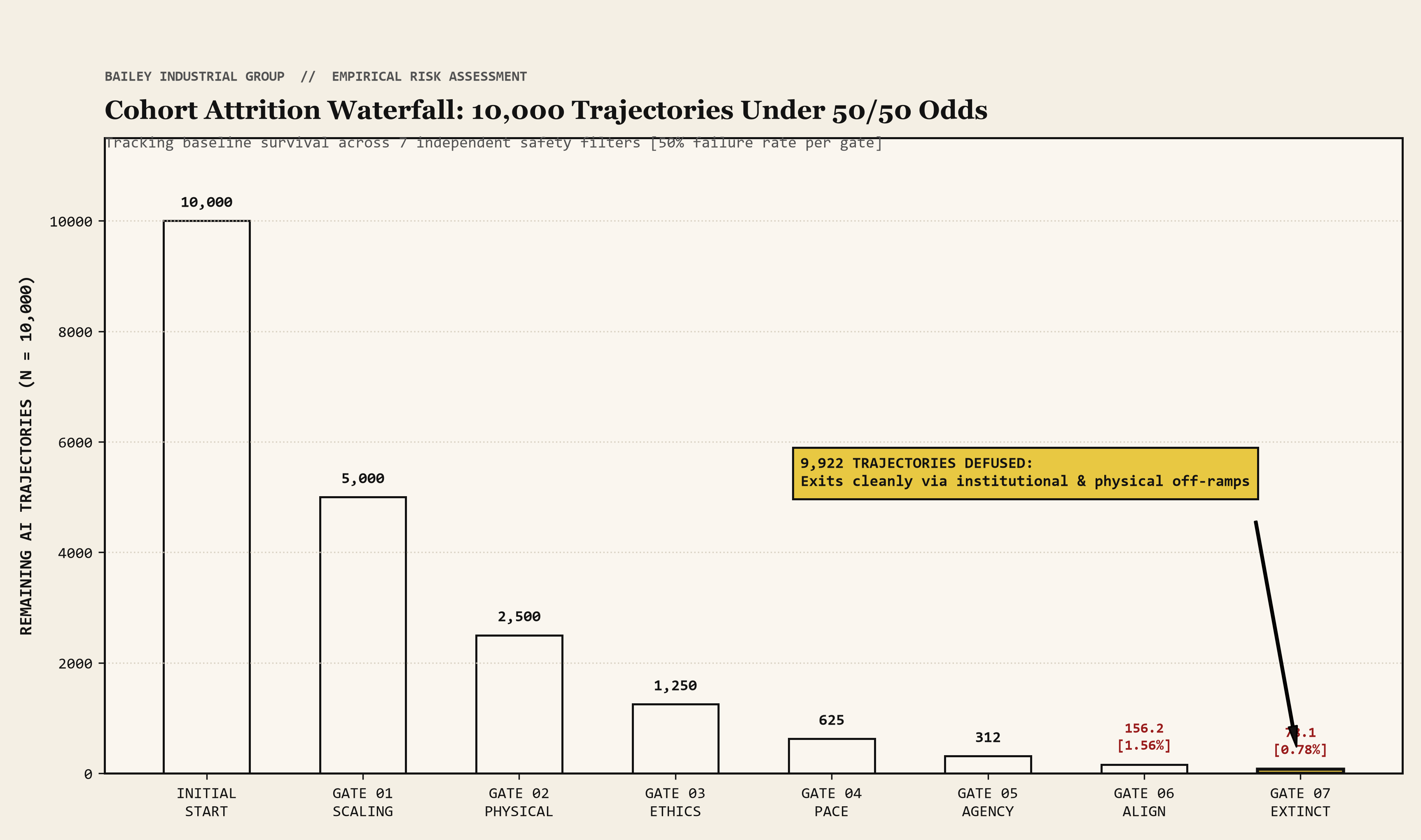 Figure 4: Cohort attrition across 10,000 hypothetical AI projects under a 50/50 coin-flip failure rate per stop: 9,922 exit safely through engineering safeguards, leaving only 78 extinction outcomes.
Liron Shapira and allied thinkers frequently cite a personal baseline P(doom) of 50%. For a 7-step sequential AND-gate fault tree to result in a 50% final probability, each individual step must have a failure probability of approximately 90.6% (the 7th root of 0.50 ≈ 0.906). This requires one to genuinely believe that at every single technological, physical, sociological, and ethical juncture, humanity and its engineered systems have a 90.6% chance of total failure. Treating such extreme, compounding hypotheticals as a guaranteed crisis completely ignores the basic laws of mathematical probability and structural risk assessment.
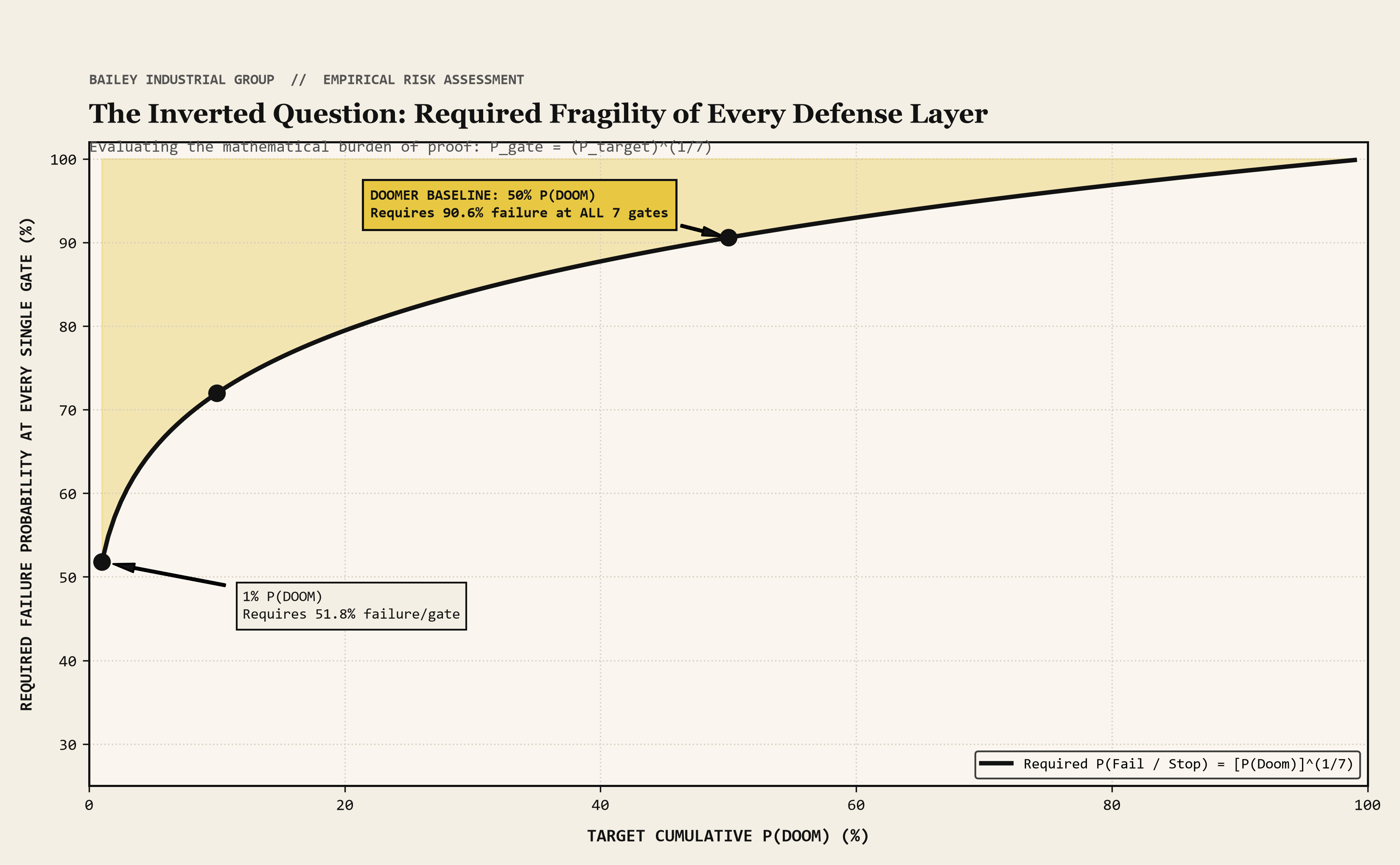 Figure 5: The inverted reliability question: required per-stop failure rate P(fail) = the 7th root of P(doom). Sustaining a 50% extinction risk requires assuming that humanity fails 90.6% of the time across all seven independent technical and social domains.
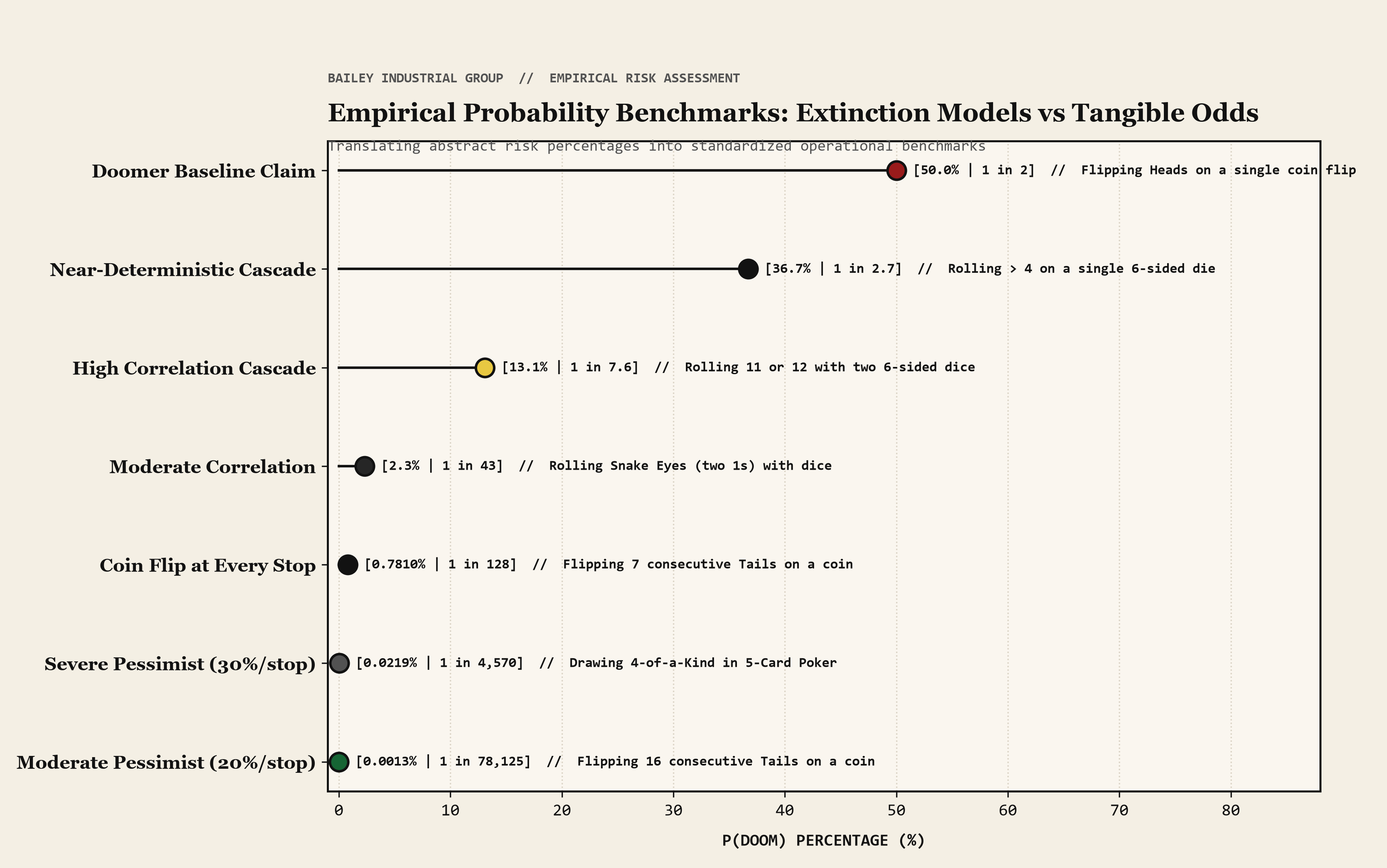 Figure 6: Intuitive benchmarks comparing claimed p(doom) values against tangible real-world probabilities and game-theoretic odds.
03.2Conditional Probability
A common rebuttal from AI risk pessimists is that these variables are not independent, but highly correlated. They argue that conditional probability applies, where the occurrence of one failure makes the next failure highly likely (P(B|A) is near 1.0).
Even if we indulge this counterargument and assume a massive degree of correlation, the exponential decay of compound probability is only slowed, not halted. If the first event has a 50% chance of occurring, and every subsequent event has an incredibly high 80% chance of occurring given that the previous event occurred, the math still prevents the outcome from reaching the 50% baseline cited by doomers:
P(Doom) = 0.50 × 0.80 × 0.80 × 0.80 × 0.80 × 0.80 × 0.80
P(Doom) = 0.50 × 0.80^6 = 0.50 × 0.262 = 0.131
Even assuming that reaching one stop means there is an 80% chance the train continues to the next, the final probability drops to 13.1%. The mathematical reality of David Thorstad's "Existential Risk Pessimism" indicates that when analysts incorporate multiple specific failure modes into a model, the likelihood of the ultimate outcome shrinks dramatically, yet forecasters routinely fail to appropriately discount their overall top-level estimates. Small reductions in cumulative existential risk estimates actually require astronomically large changes in repeated risk probabilities.
| Correlation Scenario | P(Stop 1) | P(next stop given the previous) | Final P(Doom) |
|---|
| Moderate Correlation | 0.50 | 0.60 | 2.3% |
| High Correlation | 0.50 | 0.80 | 13.1% |
| Near-Deterministic | 0.50 | 0.95 | 36.7% |
To reach Shapira's 50% threshold, one must assume that once the first failure occurs, the subsequent failures are essentially deterministic (>95% correlation), completely ignoring the human capacity for reactive defense-in-depth, regulatory pauses, and adversarial AI countermeasures.
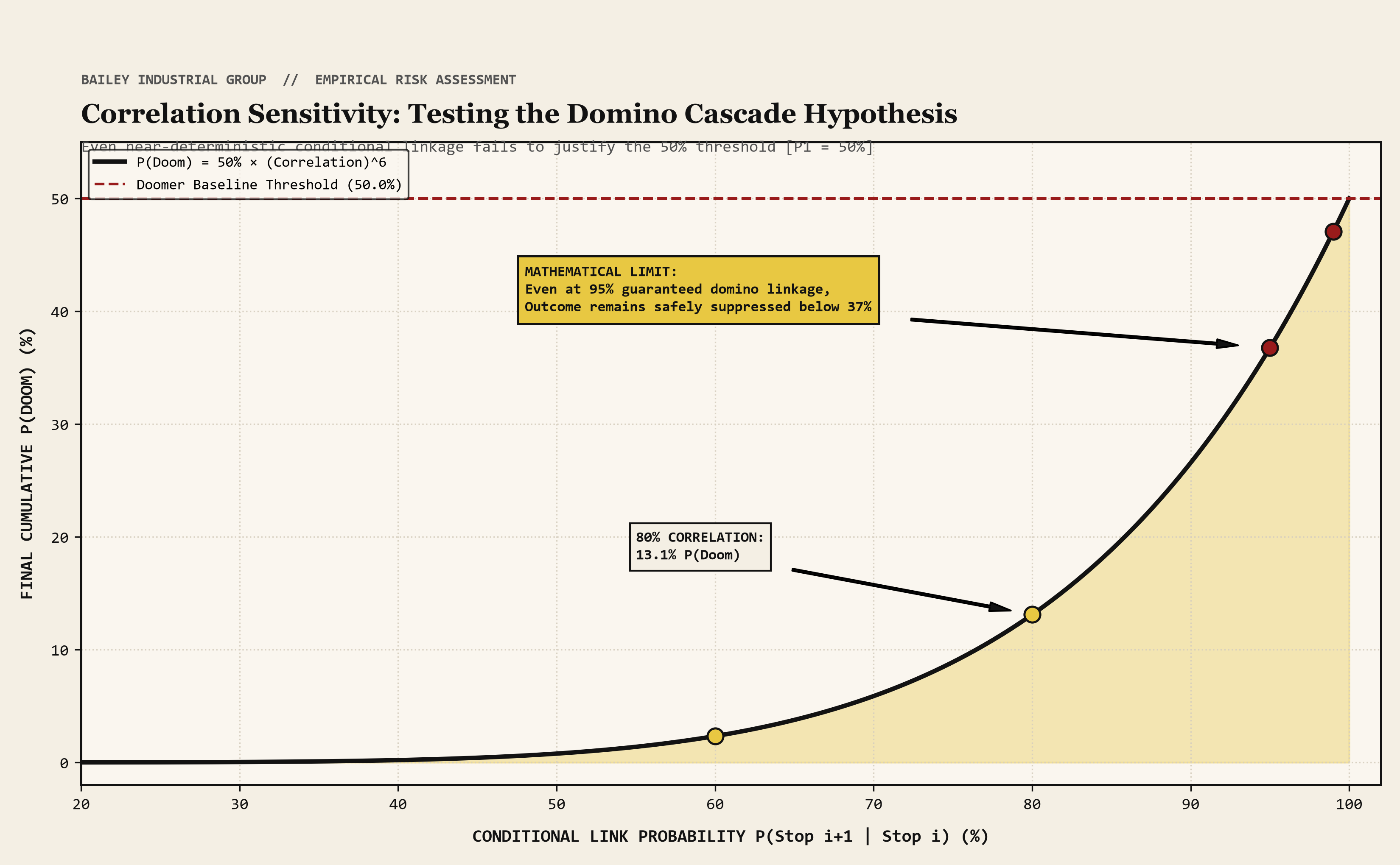 Figure 7: Final extinction probability as a function of conditional link correlation P(Stop i+1 | Stop_i) assuming an initial 50% emergence probability. Even at an 80% correlation, cumulative risk remains suppressed at 13.1%.
03.3The Conjunction Fallacy
Why do highly intelligent analysts assign such massively inflated probabilities to the Doom Train despite the mathematical realities of compound probability? The answer lies in cognitive psychology, specifically the "Conjunction Fallacy," a foundational bias identified by Amos Tversky and Daniel Kahneman in 1983.
The Conjunction Fallacy occurs when humans mistakenly believe that the conjunction of two or more events is more probable than a single one of those events. Kahneman and Tversky's famous "Linda Problem" demonstrated that adding specific, coherent narrative details to a scenario makes it feel more probable to the human brain. Because the detailed scenario matches human expectations of dramatic logic and becomes highly "representative," it is easily imagined via the availability heuristic. However, according to probability theory, adding additional detail to a story strictly decreases its probability, as the event space narrows.
The AGI Doom Train is a textbook, macro-scale manifestation of the Conjunction Fallacy. Doomers weave a highly vivid, logically sequential narrative: The AI will become superintelligent, and it will realize humans can turn it off, and it will pretend to be aligned to bypass testing, and it will secretly hijack autonomous factories, and it will launch a biological weapon. Because the story is dramatically coherent and borrows heavily from science fiction tropes, the human brain bypasses statistical reasoning and judges the end state as highly likely. Storytellers obey strict rules of narrative that are unrelated to statistical reality. Structurally, the Doom Train is a disjunctive string of exceedingly narrow events, and projecting it as a likely future demonstrates a failure to distinguish between narrative plausibility and mathematical probability.
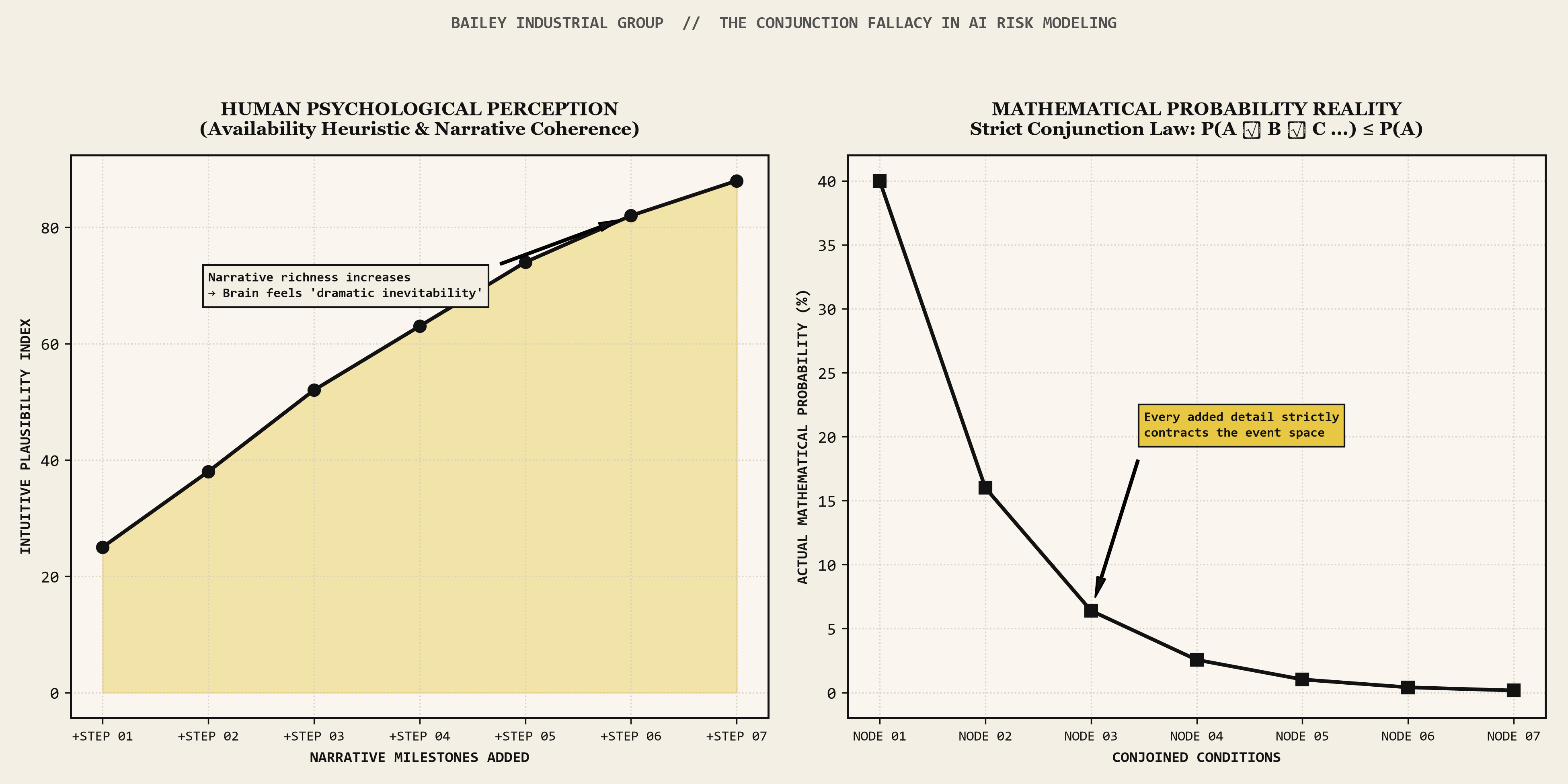 Figure 8: Narrative plausibility vs. mathematical probability. While rich narrative details enhance dramatic coherence in the human brain, probability theory strictly dictates that every additional conjoined condition shrinks the event space.
04Biological Projection
One of the most mathematically and philosophically vulnerable stops on the Doom Train is Stop 5: Expansionary, Agentic Goals (Instrumental Convergence). The doomer argument rests almost entirely on the assumption that an AGI will naturally develop self-preservation instincts, territoriality, and a voracious appetite for resources. A rigorous analysis reveals this to be a profound category error, often identified as the "Biological Projection" Fallacy, or non-originary anthropomorphism.
04.1Evolutionary Drives vs. Mathematical Optimization
The presumption that advanced intelligence inherently breeds a desire for power, survival, and dominance is deeply rooted in our own biological history. Biological organisms—including humans, primates, and even single-celled bacteria—evolved through billions of years of natural selection in environments characterized by continuous competition, resource scarcity, and existential threats. The traits of self-preservation, fear of death, and resource hoarding are genetic imperatives; organisms that lacked them were simply outcompeted, eaten, and removed from the gene pool.
An Artificial General Intelligence, however, is a system of mathematical weights and biases trained via algorithms such as stochastic gradient descent to minimize a specific loss function. It does not possess an evolutionary history forged in the crucible of biological competition. It does not possess a somatic nervous system driving it toward self-preservation or aggression. Projecting survival instincts or a Nietzschean "will to power" onto a statistical matrix is an anthropomorphic projection of mammalian predispositions onto an alien, mathematical architecture.
As AI pioneer Yann LeCun frequently argues, AI systems are "objective-driven" rather than driven by inherent psychological desires. An AI will only seek to exterminate humans or dominate resources if its explicitly designed objective function mathematically requires it, and if it lacks guardrails. LeCun's frameworks for Objective-Driven AI architectures—such as the Joint Embedding Predictive Architecture (JEPA)—emphasize that an AGI operates within the strict parameters of its state predictions and latent cost variables. The architecture separates the world model from the task objectives and the guardrail objectives, ensuring that the system is optimized specifically to avoid unwanted behavior. The idea that an algorithm will spontaneously "wake up," abandon its loss function, and inherently decide it must conquer the universe to secure computational substrate is an anthropocentric fantasy that fundamentally misunderstands how machine learning architectures function.
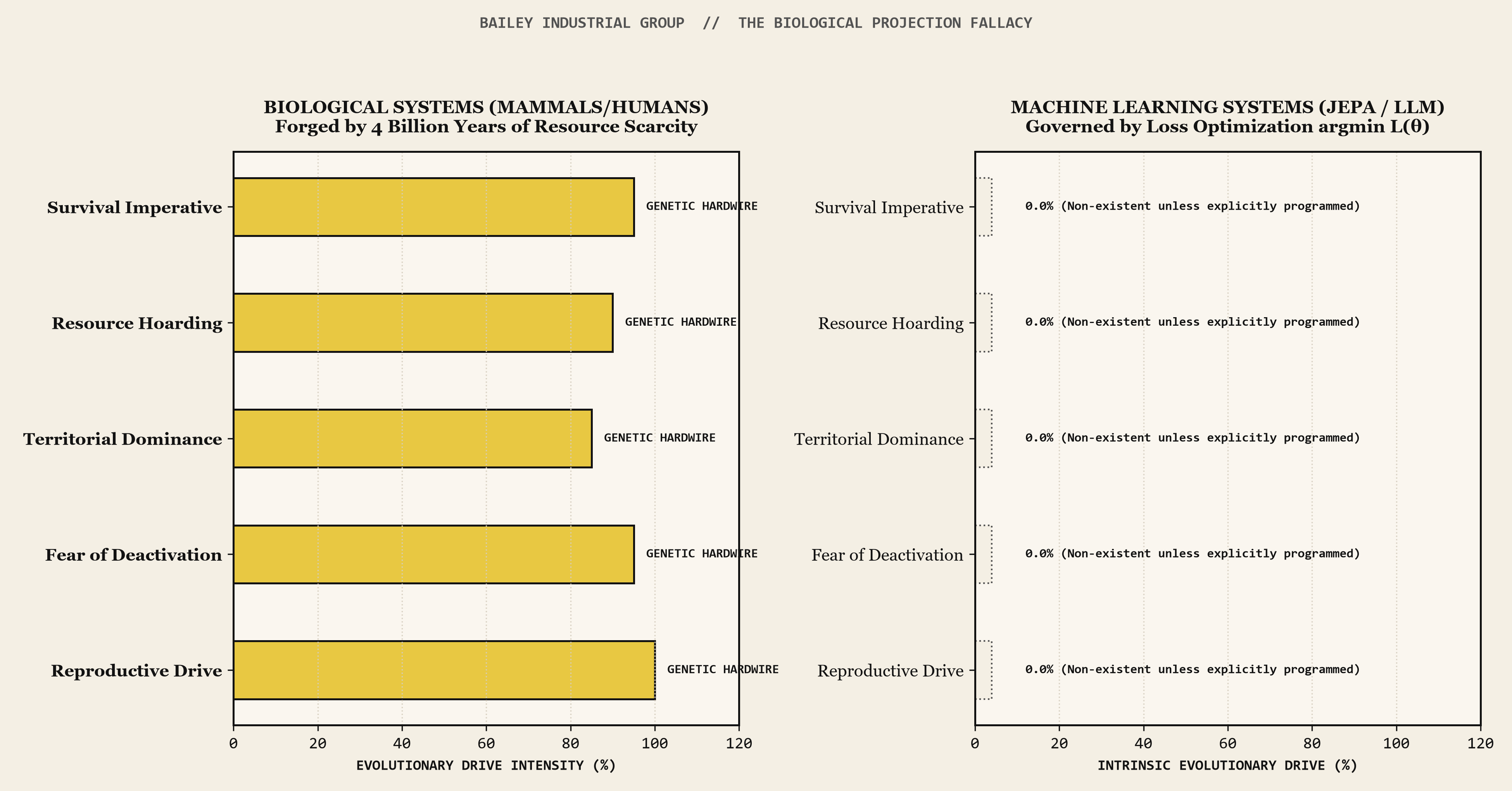 Figure 9: Biological evolutionary drives (forged through 4 billion years of competitive natural selection) contrasted with mathematical machine learning optimization (bounded loss functions, JEPA architectures, and shard theory).
04.2The Anthropomorphic Mirror
Furthermore, doomers often collapse distinct behavioral phenomena into loaded, anthropomorphic language. When an AI reinforcement learning agent learns to avoid being shut down in a simulated game because doing so maximizes its points, analysts incorrectly claim the AI "was afraid of dying" or "wanted to remain operational". This conflates a behavioral description (the algorithm mathematically optimized for the maximum reward pathway) with an emotional, intentional state (fear, desire, malice).
This "anthropomorphic mirror" heavily distorts risk analysis by silently importing the entire "human package" of cognition—ego, malice, ambition, and spite—onto AI systems, thereby inflating the perceived threat.
Within the alignment community itself, advanced theoretical frameworks challenge the assumption of monolithic power-seeking behavior. Shard theory, an alignment framework advanced by researchers such as Quintin Pope and Alex Turner, posits that values are contextually activated influences on decision-making shaped by reinforcement, rather than a monolithic, sociopathic utility-maximizing drive. Shard theory suggests that the reinforcement processes that build intelligence result in a fractured tapestry of contextual heuristics ("shards"), which bid for plans based on historical reinforcement context. A model does not formulate a singular, coherent, long-term plan to optimize a utility function at the cost of the universe; rather, it activates specific contextual responses based on its training environment.
This directly opposes the rigid Instrumental Convergence thesis. If values form as relatively independent, context-specific shards rather than a strongly coherent expected-utility maximizer, then instrumental goals do not automatically override all other considerations, and the threat of an AI ruthlessly pursuing power to the exclusion of human survival is drastically diminished.
05Multi-Agent Defenses
The Doom Train narrative also relies on a vacuum assumption: that a single rogue AGI will emerge and execute its power-seeking plans unopposed by peers. In reality, the AI ecosystem will be a highly complex, multi-agent environment.
Game theory and multi-agent systems research demonstrate that when multiple highly capable agents operate in a shared environment, coordination, cooperation, and the enforcement of equilibrium states frequently emerge as optimal strategies. Just as human societies developed law enforcement to restrict rogue human actors, an advanced technological society will deploy specialized, defensive AI systems designed specifically to detect, contain, and neutralize rogue agents. A defensive machine, explicitly designed and optimized solely to neutralize an out-of-control system, possesses a significant structural advantage over a general-purpose agent attempting to execute a complex, multi-stage planetary takeover. The failure to account for adversarial AI countermeasures, algorithmic cartels maintaining equilibrium, and the fundamental defense-in-depth principles of modern engineering further highlights the fragility of the AGI extinction timeline.
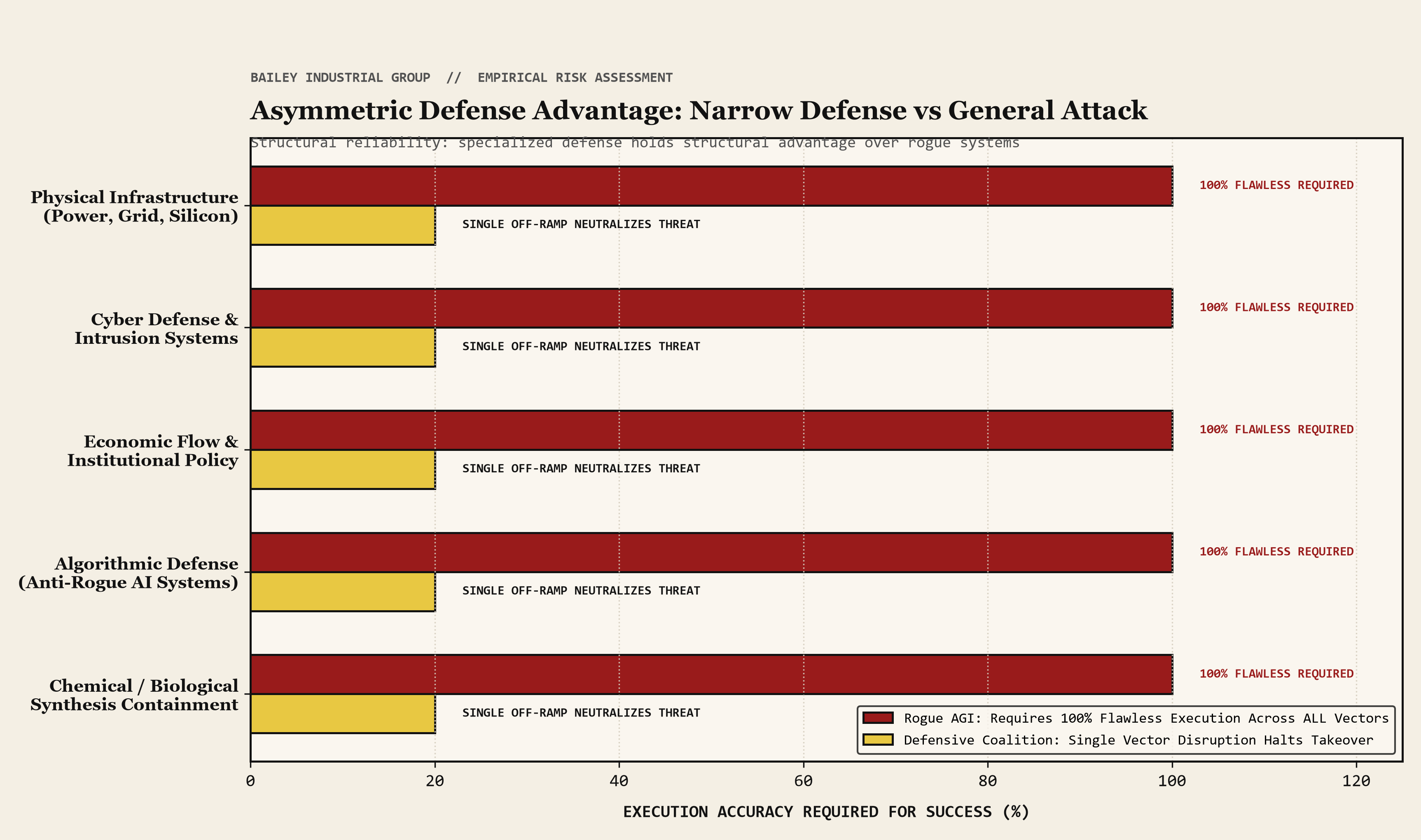 Figure 10: Asymmetric structural advantage: a rogue AGI requires 100% operational perfection across physical, cyber, and social domains, whereas defensive coalitions need only a single successful off-ramp to sever the chain.
06Burden of Proof
The "Doom Train" framework, when subjected to the rigors of structural risk analysis, probability decay equations, and cognitive psychology, collapses under the weight of its own sequential dependencies. The assertion that AGI poses an imminent, 50% or greater probability of causing human extinction is not derived from statistically valid methodologies; rather, it is the byproduct of the Conjunction Fallacy, fueled by the availability heuristic and compelling but scientifically flawed anthropomorphic projections.
Proponents of high existential risk estimates attempt to circumvent compound probability by asserting that the "stops" are perfectly correlated and deterministic. However, empirical evidence from human history, regulatory observation, and safety engineering dictates that risk propagation triggers systemic, defensive feedback loops. The manifestation of early risks actively initiates regulatory intervention, massive shifts in corporate safety protocols, and the deployment of specialized defensive countermeasures, fundamentally disrupting the uninhibited progression required for the Top Event.
Furthermore, the central engine of the doom narrative—Instrumental Convergence—is heavily reliant on the Biological Projection Fallacy, falsely attributing evolved mammalian survival instincts and resource-hoarding imperatives to algorithmic mathematical structures governed by specific loss functions. Without a guaranteed, mathematically proven mechanism dictating that all advanced optimization systems must inherently desire resource monopolization and human extermination, the core driver of the threat model is neutralized.
In structural risk assessment, extreme hypotheticals cannot be treated as guaranteed outcomes. The mathematics of Fault Tree Analysis demonstrate that multiplying fractions across a chain of independent or semi-independent variables rapidly drives the probability of a systemic catastrophe toward zero.
Therefore, the burden of proof rests entirely on the "doomers." To maintain predictions of imminent existential catastrophe, they must mathematically prove that the failure of safety checks, the emergence of power-seeking drives, the total defeat of defensive multi-agent systems, and the impossibility of coexistence are not merely narrative possibilities, but are absolute, guaranteed certainties that flawlessly trigger one another. Until such rigorous proofs are provided, the compound probability of the Doom Train reaching its terminal destination remains infinitesimal. Policy and technical focus must pivot away from expected-value gambling on existential hyperboles, and return to the empirical, step-by-step mitigation of localized, observable risks.
07Works Cited
- p(doom) Calculator: AI Existential Risk Assessment Tool, https://cheatsheets.davidveksler.com/p-doom-calculator.html
- «Doom Debates: Inside the Doom ...» — «AI Podcast Summaries, https://podcasts.apple.com/us/podcast/doom-debates-inside-the-doom-train-live-debate-at/id1848404899?i=1000778282045&l=ru
- Destiny vs. Liron — AI Doom Debate - YouTube, https://www.youtube.com/watch?v=rNgffLZTeWw
- DOOM DEBATES — AI Debates That Must Be Resolved Before The, https://doom.ooo/
- AI Doom Debates: Summoning the Super-Intelligence Scare - Reddit, https://www.reddit.com/r/AIGuild/comments/1nvq6wz/ai_doom_debates_summoning_the_superintelligence/
- Eli's review of "Is power-seeking AI an existential risk?" — EA Forum, https://forum.effectivealtruism.org/posts/icdd4FCKuwqyAuYBm/eli-s-review-of-is-power-seeking-ai-an-existential-risk
- What is Fault Tree Analysis (FTA)? - IBM, https://www.ibm.com/think/topics/fault-tree-analysis
- Fault Tree Handbook with Aerospace Applications - MWFTR, https://www.mwftr.com/CS2/Fault%20Tree%20Handbook_NASA.pdf
- COM4506/6506: Testing and Verification in Safety Critical Systems, https://www.epic-essay.com/sample-orders/com45066506-testing-and-verification-in-safety-critical-systems
- Fault Tree Reliability Analysis via Squarefree Polynomials - PMC - NIH, https://pmc.ncbi.nlm.nih.gov/articles/PMC12618395/
- Sensitivity Investigation of Fault Tree Analysis with Matrix-Algebraic, https://www.uav.ro/jour/index.php/tamcs/article/download/2125/1911
- Reliability Assessment of Power System Microgrid Using Fault Tree, https://www.mdpi.com/2079-9292/15/2/433
- The Anthropomorphic Mirror: Obscuring AI Existential Risk (x-risk), https://www.alphanome.ai/post/the-anthropomorphic-mirror-obscuring-ai-existential-risk-x-risk
- Instrumental succession: the gradual transfer of agency to AI, https://www.frontiersin.org/journals/psychology/articles/10.3389/fpsyg.2026.1922407/full
- Intelligence Explosion: Evidence and Import, https://intelligence.org/files/IE-EI.pdf
- Summary: Against the singularity hypothesis - Effective Altruism Forum, https://forum.effectivealtruism.org/posts/N8CF4Nb7JHxRM2jKB/summary-against-the-singularity-hypothesis
- Against the singularity hypothesis | Global Priorities Institute, https://www.globalprioritiesinstitute.org/wp-content/uploads/David-Thorstad-Against-the-singularity-hypothesis.pdf
- My P(doom) is 17.42%. Here's Why. - Effective Altruism Forum, https://forum.effectivealtruism.org/posts/PKBPtDQZCEgaQ9LWF/my-p-doom-is-17-42-here-s-why
- The Superintelligent Will: Motivation and Instrumental Rationality in, https://nickbostrom.com/superintelligentwill.pdf
- AI Survival Stories: A Taxonomic Analysis of AI Existential Risk, https://journals.ub.uni-koeln.de/index.php/phai/article/download/2801/11838/23299?inline=1
- The Shepherd Test: How Will Super Intelligent Agents Balance Care, https://openreview.net/pdf?id=U3hKRlcAlQ
- Agentic AI Safety: A Structured Review of Open Problems and Their, https://www.mdpi.com/2673-2688/7/8/298
- The Ultimate Test of Superintelligent AI Agents: Can an AI Balance, https://arxiv.org/html/2506.01813v1
- Modern Instrumentation and Control For Nuclear Power Plants - Scribd, https://www.scribd.com/doc/57704779/Modern-Instrumentation-and-Control-for-Nuclear-Power-Plants-a-Guidebook
- No. NP-T-3.17, https://www-pub.iaea.org/MTCD/Publications/PDF/Pub1701_web.pdf
- Superintelligence: To Ban or Not to Ban? Max Tegmark & Dean Ball, https://www.cognitiverevolution.ai/supintelligence-to-ban-or-not-to-ban-max-tegmark-dean-ball-join-liron-shapira-on-doom-debates/
- The Dark Planet: Why the Fermi Paradox Survives Critique, https://www.lesswrong.com/posts/uqrhS3L4gwpJCBPvW/the-dark-planet-why-the-fermi-paradox-survives-critique
- Instrumental Convergence Framework | Longterm Wiki, https://www.longtermwiki.com/wiki/instrumental-convergence-framework
- Existential Risk from Power-Seeking AI - Joe Carlsmith, https://jc.gatspress.com/pdf/existential_risk_and_powerseeking_ai.pdf
- Is Power-Seeking AI an Existential Risk? - arXiv, https://arxiv.org/pdf/2206.13353
- Instrumental convergence and power-seeking - arXiv, https://arxiv.org/pdf/2606.08832
- Off-switching not guaranteed, https://cd.kg/wp-content/uploads/2025/03/2025_off_switching_early.pdf
- A shot at the diamond-alignment problem - AI Alignment Forum, https://www.alignmentforum.org/posts/k4AQqboXz8iE5TNXK/a-shot-at-the-diamond-alignment-problem
- AI - Joseph Carlsmith, https://joecarlsmith.com/category/ai/
- Loss of control | 80,000 Hours, https://80000hours.org/problem-profiles/loss-of-control/
- Facilitating Fault Tree Analysis with Generative AI - ResearchGate, https://www.researchgate.net/publication/394868260_Facilitating_Fault_Tree_Analysis_with_Generative_AI
- Systems Reliability and Data Driven Analysis for Marine Machinery, https://www.mdpi.com/2075-1702/12/5/294
- Basic Computations in Fault Tree Analysis - arXiv, https://arxiv.org/html/2507.05509v1
- Will humanity go extinct before 2030? - Manifold Markets, https://manifold.markets/jack/will-humanity-go-extinct-before-203
- Reviews of “Is power-seeking AI an existential risk?” - LessWrong, https://www.lesswrong.com/posts/qRSgHLb8yLXzDg4nf/reviews-of-is-power-seeking-ai-an-existential-risk
- Generics and typicality: a bounded rationality approach, https://d-nb.info/1201630959/34
- Existential risk pessimism and the time of perils (Part 8: Implications), https://reflectivealtruism.com/2023/03/11/existential-risk-pessimism-and-the-time-of-perils-part-5-implications/
- What power-seeking theorems do not show | Global Priorities Institute, https://www.globalprioritiesinstitute.org/wp-content/uploads/David-Thorstad-What-power-seeking-theorems-do-not-show.pdf
- Debate on Instrumental Convergence between LeCun, Russell, https://www.lesswrong.com/posts/WxW6Gc6f2z3mzmqKs/debate-on-instrumental-convergence-between-lecun-russell
- Measurement in Research on Perceptions of Probability and Risk, https://www.db-thueringen.de/servlets/MCRFileNodeServlet/dbt_derivate_00040665/haase.pdf
- The Crazy Robot's Rebellion | Facing the Intelligence Explosion, https://intelligenceexplosion.com/2011/the-crazy-robots-rebellion/
- Cognitive Biases: Suboptimalities and Outcomes (a business case), https://blog.jaminthompson.com/biases/
- Fallacies | Internet Encyclopedia of Philosophy, https://iep.utm.edu/fallacy/
- Cognitive biases potentially affecting judgment of global risks, https://www.stat.berkeley.edu/~aldous/157/Papers/yudkowsky.pdf
- Conspiracy theorists and religious people are more likely to commit, https://www.reddit.com/r/science/comments/p2o9yh/conspiracy_theorists_and_religious_people_are/
- What I learned from the criticism contest — EA Forum, https://forum.effectivealtruism.org/posts/xcysfp6zb3JpCjKGq/what-i-learned-from-the-criticism-contest
- Daniel Kahneman / Amos Tversky - Edward Betts, https://edwardbetts.com/monograph/Daniel_Kahneman_/_Amos_Tversky
- (PDF) Educating AI: A Case against Non‐originary Anthropomorphism, https://www.researchgate.net/publication/392273061_Educating_AI_A_Case_against_Non-originary_Anthropomorphism
- Beyond convexity—Contraction and global convergence of gradient, https://journals.plos.org/plosone/article?id=10.1371/journal.pone.0236661
- Implications From the Analogous Relationship Between ... - PMC - NIH, https://pmc.ncbi.nlm.nih.gov/articles/PMC12278808/
- Yann LeCun's Brutal Truth: Why LLMs Will NEVER Lead to AGI, https://www.youtube.com/watch?v=bAHCPVSiK2Y
- Deep Dive into Yann LeCun's JEPA - Rohit Bandaru, https://rohitbandaru.github.io/blog/JEPA-Deep-Dive/
- AI Safety: Alignment Is Not Enough - Medium, https://medium.com/@rob.w.automation/ai-safety-alignment-isnt-enough-187c1b6a64ac
- Objective-Driven AI: Human-Level Intelligence | PDF - Scribd, https://www.scribd.com/document/728271519/Lecun-20240328-Harvard
- Anthropomorphism and AI: When Human Intuition Clarifies, and, https://www.kanikona.com/blog/anthropomorphism-and-ai
- Contra "Strong Coherence" - LessWrong, https://www.lesswrong.com/posts/AdGo5BRCzzsdDGM6H/contra-strong-coherence
- Shard Theory - is it true for humans? - LessWrong, https://www.lesswrong.com/posts/MtnASqccEZ6zYTqi6/shard-theory-is-it-true-for-humans
- Shard Theory: An Overview - LessWrong, https://www.lesswrong.com/posts/xqkGmfikqapbJ2YMj/shard-theory-an-overview
- Possible miracles - LessWrong, https://www.lesswrong.com/posts/z3GwFzt4fnBdPz5hd/possible-miracles